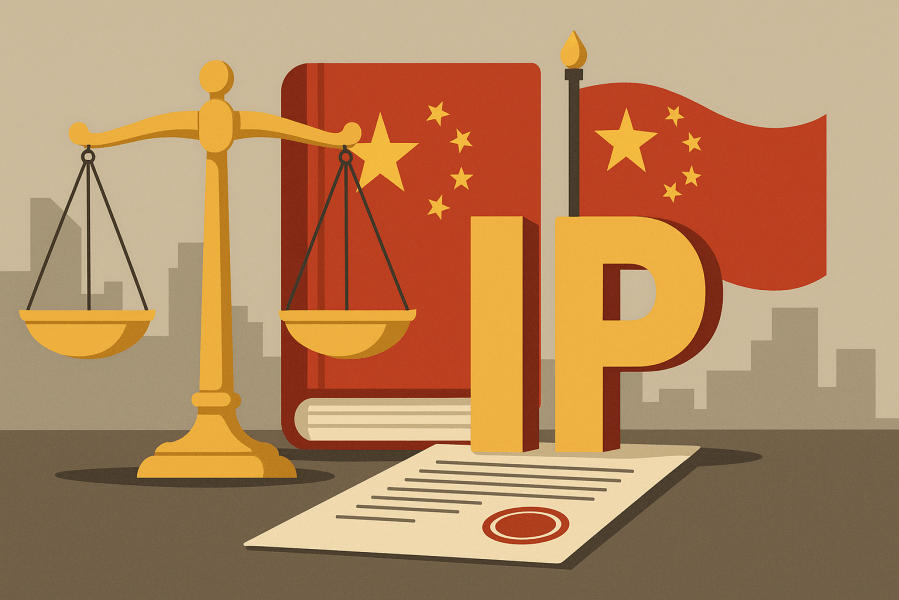
China has issued a State Council regulation on the handling of foreign-related disputes in the field of intellectual property (IP), providing a framework for managing such disputes. With this new regulation, China has created a markedly more protectionist legal environment that goes far beyond traditional issues of industrial property rights. The regulation explicitly defines IP as a critical tool for China’s development in future technologies.
For European companies operating in China, this presents both legal and strategic challenges. For instance, international cooperation in evidence collection is restricted, as Article 12 stipulates that China will only cooperate with foreign authorities in accordance with its own laws. This may result in significant delays for European companies that rely on evidence from China in cross-border IP proceedings.
In addition, Article 13 establishes that Chinese rules on technology transfer, data protection, state secrets, and privacy take precedence—meaning that data disclosure requests can be denied even if backed by foreign court rulings. Particularly relevant for contract design is Article 14, which allows Chinese authorities to investigate certain foreign IP practices as unfair competition. These include clauses that prevent Chinese licensees from challenging the validity of IP rights, as well as coercive licensing terms or re-licensing obligations. While such clauses are common in many European licensing models, they could become legally problematic in China moving forward.
The regulation also carries significant geopolitical risks. Article 15 permits targeted countermeasures against countries perceived as discriminatory toward China, while Article 16 prohibits Chinese companies from supporting such foreign legal actions. Should Europe be classified as discriminatory—e.g., due to EU legislation or sanctions— European firms could face retaliatory measures in IP proceedings or restricted market access in China. Moreover, the scope of the regulation remains unclear, particularly regarding what constitutes a foreign-related dispute. Legal uncertainty is likely to grow, especially in contexts involving international supply chains, joint ventures, or research collaborations.
Against this backdrop, European companies in China must reassess and adapt their IP strategies. Contracts should be reviewed for critical IP clauses and redesigned as needed. Joint venture agreements should include clearly defined roles and technology boundaries. Proprietary rights, such as trademarks and patents, should be registered in China without delay, and know-how should be protected through internal technical safeguards. In the area of data and technology transfer, compatibility with Chinese law must be ensured—possibly through local hosting solutions.
Companies would also be well advised to refrain from participating in legal proceedings that China may perceive as discriminatory. Finally, establishing an internal early warning system to monitor legal and political developments is essential to respond proactively. Overall, the new IP regulation underscores that intellectual property in China is increasingly viewed as a geopolitical instrument. For European SMEs, this means greater uncertainty, more complex legal requirements, and the need to realign local compliance and IP strategies accordingly.
Source: State Council of the People’s Republic of China


 China Intellectual Property Blog