
With the new Guiding Opinions on Improving the Quality of Products and Services on Online Trading Platforms, China has tightened the rules for e-commerce. The document marks a shift away from purely volume-driven growth and a transition toward a quality-oriented strategy for online commerce. This results in new requirements for European brands and exporters in… Continue reading Digital Product Passport and Live Shopping Blacklist
Category: Innovation
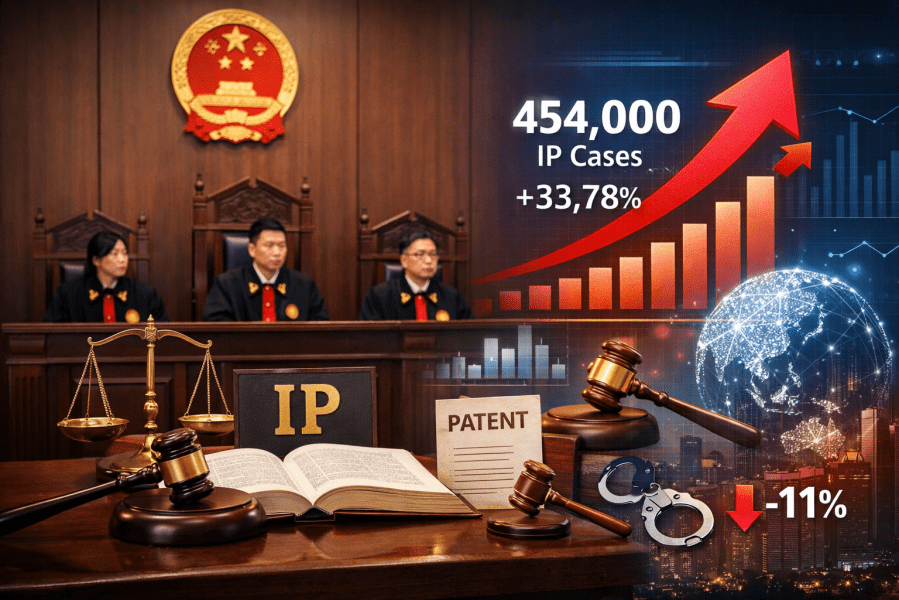
Trends in China’s IP case law 2025
While the total number of court cases in China is declining slightly, the importance of IP jurisdiction is increasing noticeably. In civil IP proceedings, the courts recorded 454,000 new cases between January and September 2025, an increase of 33.78 per cent over the previous year. In contrast, the total number of proceedings fell by a… Continue reading Trends in China’s IP case law 2025

IP in the new Five-Year Plan
The new Chinese Five-Year Plan (2026–2030) reveals China’s strategic intention to establish IP not only as a legal instrument, but also as a fundamental pillar of technological sovereignty and economic competitiveness. The plan aims to transform China from a user of IP systems to a leading designer and beneficiary. To this end, IP legal protection… Continue reading IP in the new Five-Year Plan

China’s global AI strategy
The global race for AI supremacy is in full swing. The Chinese government recently published the Global AI Governance Action Plan and at the same time presented drafts for ethical AI rules and labelling requirements for AI-generated content — a clear signal of the strategic shift from pure development to global regulation and standard setting.… Continue reading China’s global AI strategy

China standardizes the Metaverse
Shanghai is going on the offensive with the publication of the first national group standard for the metaverse. The measure is a clear indication that China does not view the metaverse as just a gimmick or niche market, but as a fundamental new infrastructure for the economy and society of the future. By combining standardized… Continue reading China standardizes the Metaverse

The launch of digital identity
On July 15, 2025, China officially introduced digital identities (digital IDs) – a centralized, state-controlled system for authenticating individuals online. The National Cyber ID Authentication consists of a combination of numbers and letters and is mandatory for using many online services. To register, citizens must upload their identity documents, have their face scanned, and provide… Continue reading The launch of digital identity

AI Protection through Competition Law
The Beijing Intellectual Property Court recently issued a landmark ruling that gives new weight to the protection of AI models under China’s Anti-Unfair Competition Law. In this case, Beijing Douyin Technology Co., Ltd., the operator of the popular Douyin app (known internationally as TikTok), sued Yirui Ke Information Technology (Beijing) Co., Ltd., the operator of… Continue reading AI Protection through Competition Law

Chinese AI Oversupply
China’s tech industry is currently experiencing an unprecedented investment boom in the field of artificial intelligence, triggered by the use of the advanced model DeepSeek. Xiaomi plans to invest over RMB 7 billion in AI innovation and China Unicom announced RMB 55 billion of investment, with a significant proportion going to AI-driven telecommunications infrastructure modernization.… Continue reading Chinese AI Oversupply

Outflow of Intellectual Capital from China
The business model has been highly profitable: foreign companies invest in China, take advantage of its low-cost resources, and then export their products worldwide with attractive margins. In the eyes of the Chinese government, a similar pattern is now emerging in research and development—foreign companies are tapping into China’s knowledge resources through their R&D centers… Continue reading Outflow of Intellectual Capital from China

Proxy cyberwarfare with AI agents
The risk that autonomous AI agents will independently detect vulnerabilities and exploit them as attack vectors is no longer a futuristic scenario – it has become a tangible and rapidly escalating threat. Unlike traditional tools for automated vulnerability scanning, modern AI agents like AutoGPT or SWE-agent operate with a high degree of autonomy. They can… Continue reading Proxy cyberwarfare with AI agents