
China aims to systematically strengthen the foundations of its industry—from core components and raw materials to basic software. The five-year plan, published on October 22, 2026, targets segments in which European suppliers have traditionally been strong. This will intensify competition in China and make the protection of know-how even more critical. By 2030, vulnerabilities are… Continue reading New Plan: Strengthening the Industrial Base

Tighter Export Controls for 40 Key Technologies
China is planning new export restrictions on 40 strategically important technologies. Artificial intelligence, biomedicine, and solar technology are particularly affected. For European companies, this could result in significant restrictions on technology transfer and the use of Chinese know-how. The Chinese Ministry of Commerce (MOFCOM) and the Ministry of Science have published a draft proposal to… Continue reading Tighter Export Controls for 40 Key Technologies

Stricter Oversightand Liability for AI
China is further tightening regulatory controls in the areas of cybersecurity, data protection, and artificial intelligence. Two new sets of regulations expand the government’s oversight powers and clarify legal liability for AI applications. For European companies with Chinese subsidiaries, this results in additional requirements regarding compliance, documentation, and risk management. New regulations from the Chinese… Continue reading Stricter Oversightand Liability for AI

Norway’s Warning About Chinese Electric Vehicles
The case has caused a stir. Norwegian researchers drove a Chinese electric bus operated by Oslo’s public transit agency, Ruter, into a mine to cut off its wireless connection to the outside world. Nevertheless, the bus continued to attempt to send data back to its home base. The test revealed that the Chinese Yutong bus… Continue reading Norway’s Warning About Chinese Electric Vehicles

Your Brands Must Be Visible to AI
Chinese AI models such as Alibaba’s Qwen, DeepSeek, and ByteDance’s Doubao are transforming e-commerce—and with it, the conditions for European brands in China. Product search, recommendations, customer service, marketing, and livestreaming are increasingly driven by AI. As a result, brand visibility is being influenced more and more by algorithms. This is particularly evident at Alibaba.… Continue reading Your Brands Must Be Visible to AI

China’s New Trademark Law
On June 26, 2026, China enacted a comprehensive revision of its Trademark Law, which will take effect on January 1, 2027. This marks a significant shift in policy: In the future, the focus will no longer be solely on registration, but increasingly on the actual use of a trademark and the applicant’s good faith. Trademark… Continue reading China’s New Trademark Law
Extraterritorial Legal Claims
The case involving the Chinese security firm Nuctech illustrates the extent to which extraterritorial legal claims are increasingly shaping global trade. Under the Foreign Subsidies Regulation (FSR), the EU is investigating potential competition-distorting Chinese subsidies and is demanding extensive information on financing and state support. Beijing reacted sharply and, for the first time, officially prohibited… Continue reading Extraterritorial Legal Claims
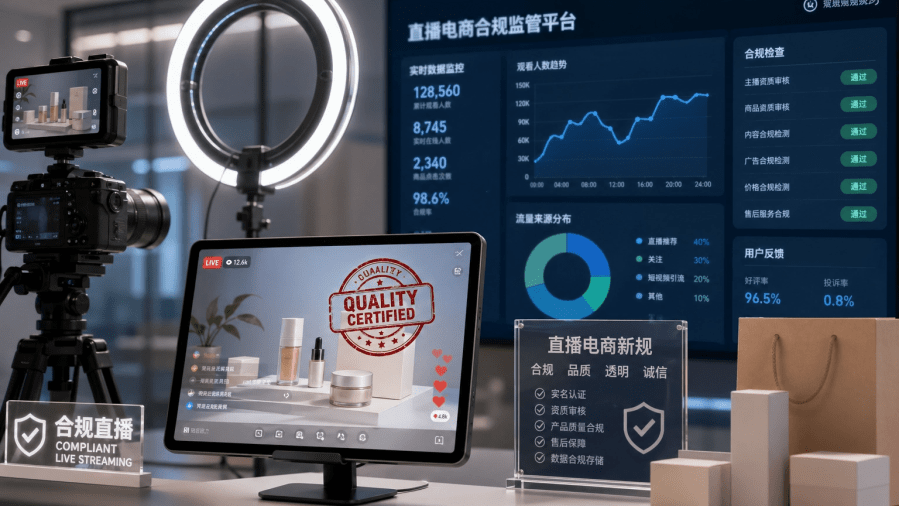
Digital Product Passport and Live Shopping Blacklist
With the new Guiding Opinions on Improving the Quality of Products and Services on Online Trading Platforms, China has tightened the rules for e-commerce. The document marks a shift away from purely volume-driven growth and a transition toward a quality-oriented strategy for online commerce. This results in new requirements for European brands and exporters in… Continue reading Digital Product Passport and Live Shopping Blacklist
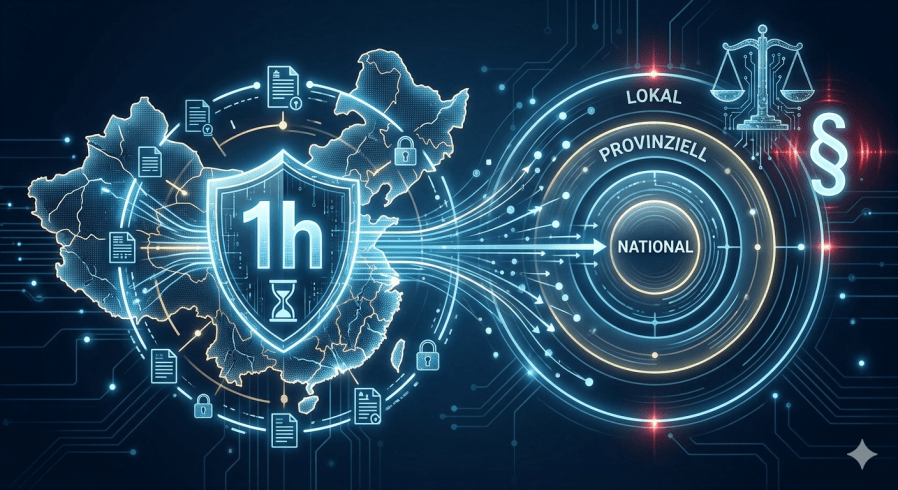
Cybersecurity: Tightening of Reporting Requirements
China is once again tightening regulatory requirements for companies operating in the digital space. The National Measures for the Management of Cybersecurity Incident Reporting took effect on November 1, 2025, and clarify the obligations set forth in the CSL, DSL, and PIPL. This further tightens the compliance regime for companies doing business in China. At… Continue reading Cybersecurity: Tightening of Reporting Requirements
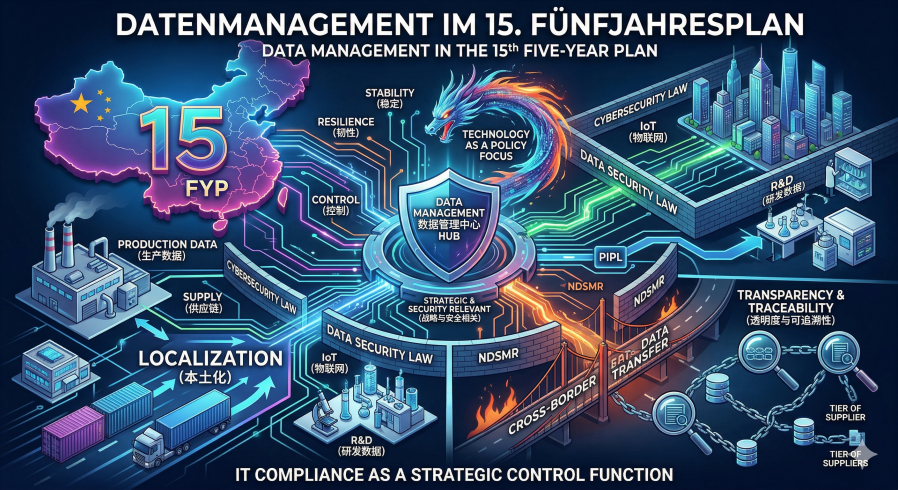
Data in the 15th Five-Year Plan
The 15th Five-Year Plan (2026 – 2030) marks a strategic reorientation in the handling of data. While the economic use of data and the creation of value from it continue to be specifically promoted, data security is simultaneously defined as a fundamental prerequisite for stability. As a result, data is being given greater economic value… Continue reading Data in the 15th Five-Year Plan