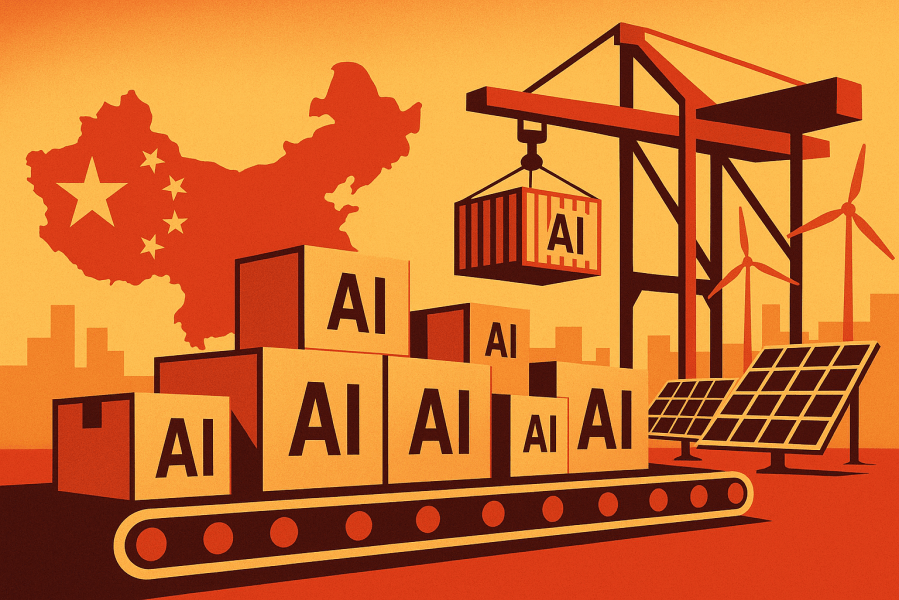
China’s tech industry is currently experiencing an unprecedented investment boom in the field of artificial intelligence, triggered by the use of the advanced model DeepSeek. Xiaomi plans to invest over RMB 7 billion in AI innovation and China Unicom announced RMB 55 billion of investment, with a significant proportion going to AI-driven telecommunications infrastructure modernization. Meanwhile, the AI-supported international business of financial services provider FinVolution now accounts for more than a fifth of its revenue, with over 2.2 million new borrowers acquired outside China in the last quarter alone.
It is obvious that the rapid growth and increasing homogeneity of AI strategies will lead to oversupply and shrinking margins. China will export its AI worldwide, as it already does with electric cars, wind turbines and solar panels. The coming AI flood will have consequences for European companies that operate in China or compete internationally with Chinese companies. For example, Chinese companies can develop and scale AI applications at a fraction of the previous cost, giving them massive efficiency and innovation advantages. European companies must therefore expect significantly shorter innovation cycles and more aggressive competitors that can respond more quickly to customer needs and scale more cheaply.
In China and globally, the expectations of customers and partners regarding the performance, speed of adaptation and price structure of AI solutions will change dramatically. If Chinese providers offer AI services that are 20 to 40 times cheaper but of comparable quality, European providers will come under pressure to rethink their own services, form new alliances or offer significantly lower prices.
For European companies that are active in China or process data there, the question arises as to whether they should rely on Chinese AI service providers such as DeepSeek, which would bring short-term cost advantages but could create dependencies in terms of technology, data control and compliance in the long term. European companies may be forced to focus on niche or B2B special solutions – for example in industrial automation, medical technology or the use of AI in highly regulated areas. Technological leadership is increasingly concentrated in the hands of a few large providers, while European players will have to differentiate themselves through quality, domain knowledge and trustworthiness.
If customers come to perceive AI functions such as text generation, translation or image recognition as a commodity, their willingness to pay will decrease. This also affects European companies that offer their own SaaS solutions with AI. If Chinese solutions offer the same functions for free or at a significantly lower cost, there is a risk of price erosion and margin pressure.
European companies should cooperate with Chinese AI providers to implement innovative applications faster – especially when local customization and large amounts of data are required. A solid legal and technical due diligence is a prerequisite to ensure data protection, IP protection and compliance with EU and Chinese law.
Chinese providers are gaining a competitive edge in terms of AI scalability, price and user base. Suppliers, integrators and service providers who want to survive must have clear technological or ethical USPs – be it in terms of transparency, quality, fairness or sustainability of AI. As a consequence, there is a strategic need for repositioning in global AI value chains.


 China Intellectual Property Blog