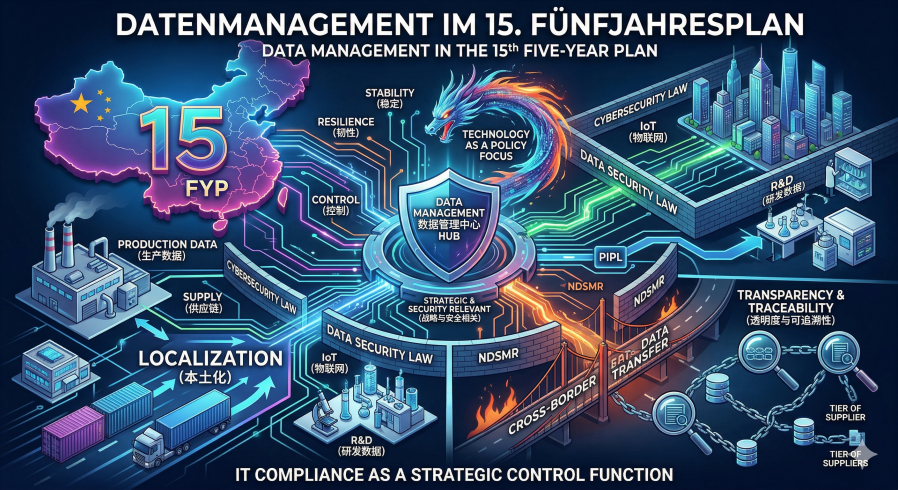
The 15th Five-Year Plan (2026 – 2030) marks a strategic reorientation in the handling of data. While the economic use of data and the creation of value from it continue to be specifically promoted, data security is simultaneously defined as a fundamental prerequisite for stability. As a result, data is being given greater economic value while simultaneously taking on security policy significance. It is evolving from a byproduct of digital processes into an independent strategic resource. Data flows, data storage, and data processing are increasingly subject to security policy considerations and are treated as potentially critical infrastructure, particularly in sensitive sectors.
Stability takes precedence over pure growth – a concept that, in the Chinese context, is closely linked to control, risk minimization, and the state’s ability to steer the economy. For companies, this means that data can no longer be viewed exclusively from economic or technical perspectives but always possesses a geopolitical dimension as well. Already, there are signs of further consolidation of existing regulations on data localization, data security, and cross-border data transfers.
Requirements for transparency and traceability are rising significantly. They necessitate comprehensive data collection, integration, and control. Companies must therefore not only generate and process more data but also maintain it in a structured, auditable, and regulatory-compliant manner. Data management and data security are thus becoming central prerequisites for compliance and market access. The plan places greater emphasis on measures to localize and secure supply chains, for example through continuous risk monitoring, the development of alternative capacities, and the control of critical technologies.
This creates an increasingly complex regulatory environment for foreign companies. Data localization requirements are tightening, cross-border data flows are subject to stricter restrictions, and the use of foreign IT infrastructures is being scrutinized more closely. In practice, this leads to a structural separation between global and China-specific IT and data architectures. At the same time, requirements for auditability, transparency, and compliance are rising significantly, tying up additional organizational and technical resources.
This results in a fundamental shift in perspective: data is no longer merely an IT or compliance issue, but a core strategic factor in China-specific architecture. It exists at the intersection of economic utilization, regulatory control, and geopolitical requirements and must therefore be holistically integrated into corporate strategy, IT structures, and governance.


 China Intellectual Property Blog