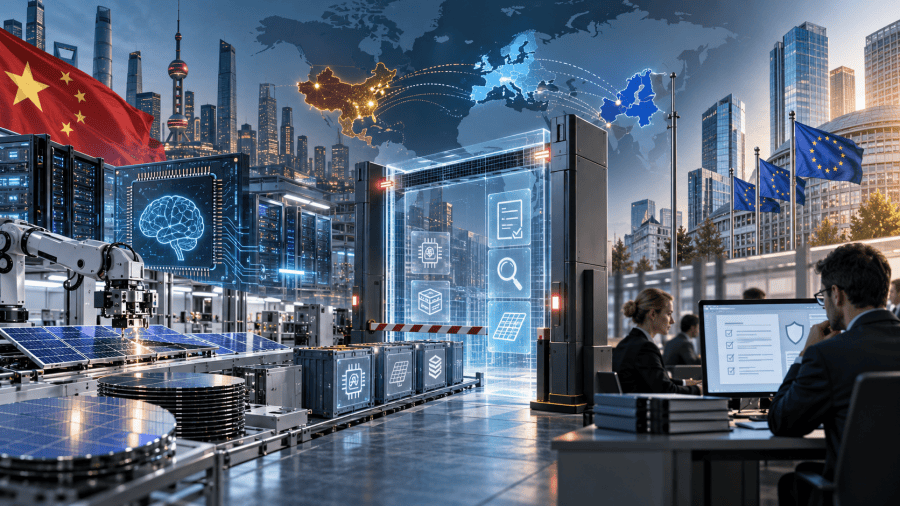
China is planning new export restrictions on 40 strategically important technologies. Artificial intelligence, biomedicine, and solar technology are particularly affected. For European companies, this could result in significant restrictions on technology transfer and the use of Chinese know-how.
The Chinese Ministry of Commerce (MOFCOM) and the Ministry of Science have published a draft proposal to this effect. A complete export ban is planned for 14 technologies, while another 26 will require a license. Twenty-three entries pertain to artificial intelligence, including large AI models and autonomous AI agents. Beijing cites security risks in particular as the rationale for the measures.
The restrictions distinguish between the use of Chinese AI services and actual technology transfer. Access via apps, websites, and application programming interfaces (APIs) is to remain possible. In contrast, installing certain Chinese AI models on one’s own servers outside of China could require a license in the future. Technologies already publicly available, including open-source models, are to remain exempt.
Twelve entries pertain to the solar industry, specifically manufacturing processes for polysilicon, silicon wafers, and solar cells. Production facilities, as well as the transfer of technical know-how related to the installation and commissioning of foreign factories, could also fall under the restrictions. The export of finished solar modules, however, remains largely unaffected.
Although the final regulations have not yet been issued, provisional registration requirements have been in effect since October 16, 2026. Exporters must specify the recipient, destination country, and intended use of the technologies. Comments on the draft may be submitted until November 15, 2026.
This creates new compliance risks for European companies in the areas of research collaborations, technology licensing, AI implementations, and international production projects. They should assess whether Chinese partners are providing controlled know-how and whether existing contracts need to be amended. This development shows that China is increasingly controlling the international outflow of its own technological expertise. As a result, Chinese export controls are becoming even more important for international IP and know-how risk management。