
Revised patent examination guidelines have come into force in China, significantly tightening the requirements for inventions in the field of artificial intelligence. They make it clear that technical innovation is no longer sufficient for patenting. In the future, patentable AI solutions must also be legally permissible, ethically acceptable, and technically transparent. Examiners place particular emphasis… Continue reading Stricter requirements for AI patents
Category: IP
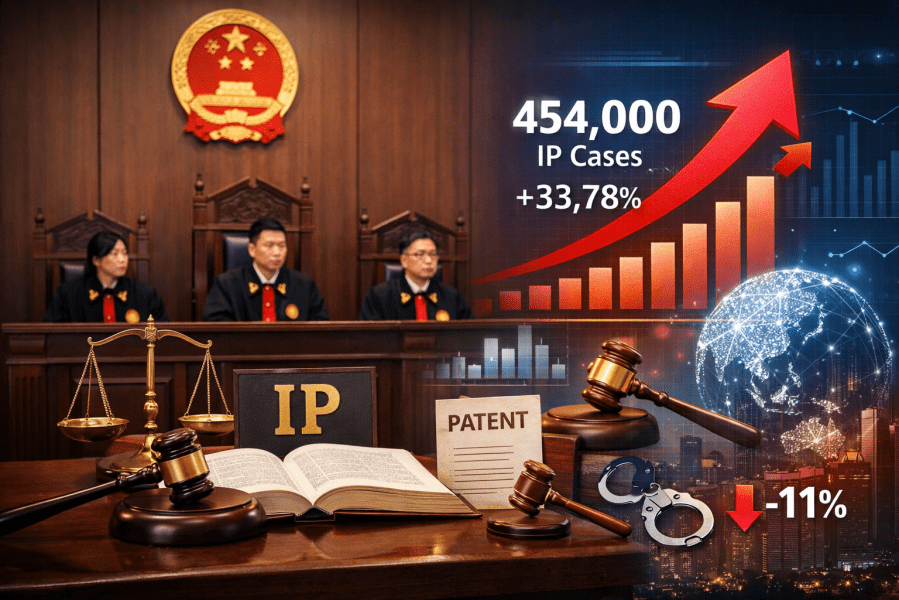
Trends in China’s IP case law 2025
While the total number of court cases in China is declining slightly, the importance of IP jurisdiction is increasing noticeably. In civil IP proceedings, the courts recorded 454,000 new cases between January and September 2025, an increase of 33.78 per cent over the previous year. In contrast, the total number of proceedings fell by a… Continue reading Trends in China’s IP case law 2025

IP in the new Five-Year Plan
The new Chinese Five-Year Plan (2026–2030) reveals China’s strategic intention to establish IP not only as a legal instrument, but also as a fundamental pillar of technological sovereignty and economic competitiveness. The plan aims to transform China from a user of IP systems to a leading designer and beneficiary. To this end, IP legal protection… Continue reading IP in the new Five-Year Plan

China standardizes the Metaverse
Shanghai is going on the offensive with the publication of the first national group standard for the metaverse. The measure is a clear indication that China does not view the metaverse as just a gimmick or niche market, but as a fundamental new infrastructure for the economy and society of the future. By combining standardized… Continue reading China standardizes the Metaverse

Counterfeit Hub Hainan
At the end of 2025, China will fully open Hainan to free trade – a radically liberalized economic zone without traditional customs controls, with simplified compliance, open data flows, and tax breaks. What at first glance appears to be a strategic modernization raises serious questions from a European perspective, however, particularly with regard to intellectual… Continue reading Counterfeit Hub Hainan

Chinese offensive in Europe: Focus on IP and IT
The Allianz Trade Global Survey 2025 clearly shows that Chinese companies are strategically reorienting themselves as a result of the escalating trade conflict with the US and are increasingly turning their attention to Europe. Since American Liberation Day on April 2, 2025, not a single Chinese company with existing supply chains in North America has… Continue reading Chinese offensive in Europe: Focus on IP and IT

AI Protection through Competition Law
The Beijing Intellectual Property Court recently issued a landmark ruling that gives new weight to the protection of AI models under China’s Anti-Unfair Competition Law. In this case, Beijing Douyin Technology Co., Ltd., the operator of the popular Douyin app (known internationally as TikTok), sued Yirui Ke Information Technology (Beijing) Co., Ltd., the operator of… Continue reading AI Protection through Competition Law

China’s IP Reform: Opportunities,Obligations, and Risks
On April 24, 2025, the China National Intellectual Property Administration (CNIPA) published an article highlighting key developments in China’s intellectual property (IP) system. At the heart of these developments is China’s continued effort to strengthen the legal protection of patents, trademarks, and copyrights, and to better align domestic legislation with international standards. This shift reflects… Continue reading China’s IP Reform: Opportunities,Obligations, and Risks

Partial Designs as an IP Strategy
Partial designs have been officially protected under Chinese Patent Law since 2021 – a significant development for companies seeking to safeguard individual design elements such as sole patterns, graphical user interfaces, or packaging details. Unlike traditional design patents, which protect the overall appearance of a product, partial designs allow for the targeted protection of particularly… Continue reading Partial Designs as an IP Strategy

Outflow of Intellectual Capital from China
The business model has been highly profitable: foreign companies invest in China, take advantage of its low-cost resources, and then export their products worldwide with attractive margins. In the eyes of the Chinese government, a similar pattern is now emerging in research and development—foreign companies are tapping into China’s knowledge resources through their R&D centers… Continue reading Outflow of Intellectual Capital from China

 China Intellectual Property Blog