
The Cyberspace Administration of China, the Ministry of Industry and Information Technology, the Ministry of Public Security, and the National Radio and Television Administration have jointly issued new regulations introducing mandatory labeling for AI-generated content. These measures will take effect on September 1, 2025, and require platforms to clearly mark content created by AI systems.… Continue reading Labeling Requirements for AI-Generated Content
Category: IP
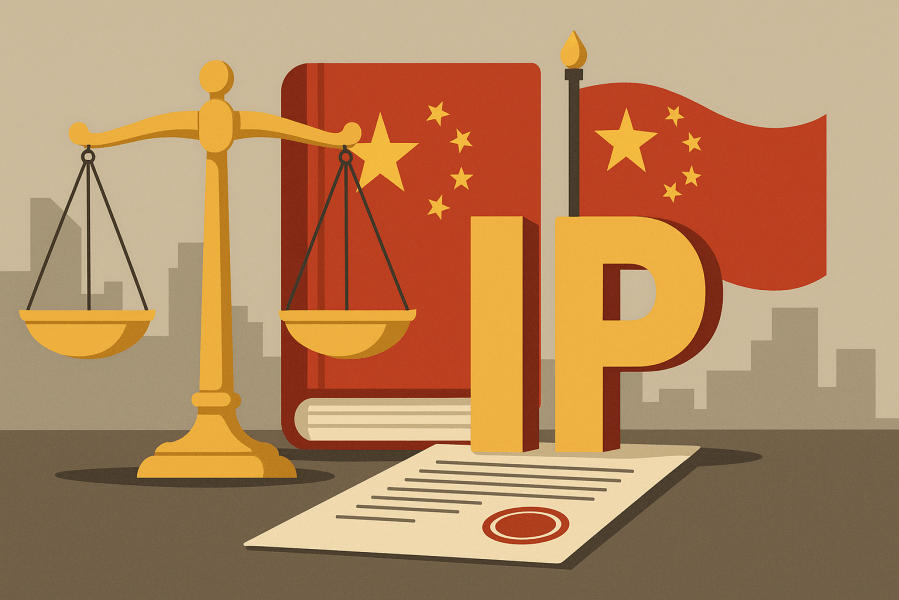
China’s New IP Regulation
China has issued a State Council regulation on the handling of foreign-related disputes in the field of intellectual property (IP), providing a framework for managing such disputes. With this new regulation, China has created a markedly more protectionist legal environment that goes far beyond traditional issues of industrial property rights. The regulation explicitly defines IP… Continue reading China’s New IP Regulation

Taiwan: Burden of Proof Regarding the State of the Art
In a recent decision (2023 Xing Zhuan Su Zi No. 16), the Intellectual Property Court of Taiwan set important standards regarding the burden of proof in assessing inventive step and the admissibility of supplementary experimental data. The case concerned Taiwanese Patent No. I682882, which describes a biodegradable composition. The patent holder faced an invalidation action… Continue reading Taiwan: Burden of Proof Regarding the State of the Art

Leveraging Open Source in China
Open-source technologies are freely available in China, even for European companies. However, to truly benefit from developments in the Chinese open-source ecosystem, European firms must actively engage with the community, establish collaborations, and leverage the expertise of Chinese specialists. This presents a significant opportunity, particularly for medium-sized enterprises, to catch up technologically and enhance their… Continue reading Leveraging Open Source in China

Fake-Monitoring in Live-Commerce
As Chinese manufacturers face increasing obstacles in the U.S. due to American tariffs, they are now shifting their focus more aggressively toward Europe. This new Chinese brand offensive is also evident in the rapid expansion of e-commerce platforms such as Shein, Temu, and TikTok Shop. These companies leverage innovative sales strategies to fundamentally reshape the… Continue reading Fake-Monitoring in Live-Commerce

Certification Marks Secure Trust in China
A certification mark does not serve to distinguish a company from its competitors but guarantees specific quality characteristics of goods or services. Examples include the Fairtrade seal, which ensures fair trading conditions for producers, or the TÜV mark, which confirms safety and quality testing by TÜV. The Blue Angel, which stands for environmentally friendly products,… Continue reading Certification Marks Secure Trust in China

Cost-Efficient Anti-Counterfeiting
In times of economic uncertainty and tight budgets, many companies face the challenge of optimizing their anti-counterfeiting efforts (ACF) in China without sacrificing effectiveness. Completely halting ACF is not an option, as this would lead to a resurgence of suppressed piracy and render previous investments futile. The financial damage from short-term revenue losses (often 3–5%… Continue reading Cost-Efficient Anti-Counterfeiting

Legal tech boosts the Resilience
Given the declining Chinese economy, politically induced increasing uncertainty, and the decoupling of IP systems between China and the West, the use of Legal Tech in the field of intellectual property often proves to be a significant advantage for companies. Legal Tech not only reduces costs, increases efficiency, and speeds up processes, but it also… Continue reading Legal tech boosts the Resilience

Promotion of Data Flow and Protection of Data Rights
China has issued a new landmark ruling in the field of key digital technologies. It concerns data extraction and data trading by iDataAPI and demonstrates China’s strengthened stance on protecting data rights and promoting data flow. The operator of Sina Weibo (plaintiff) sued a company and its subsidiary in Shenzhen, the operator of the iDataAPI… Continue reading Promotion of Data Flow and Protection of Data Rights
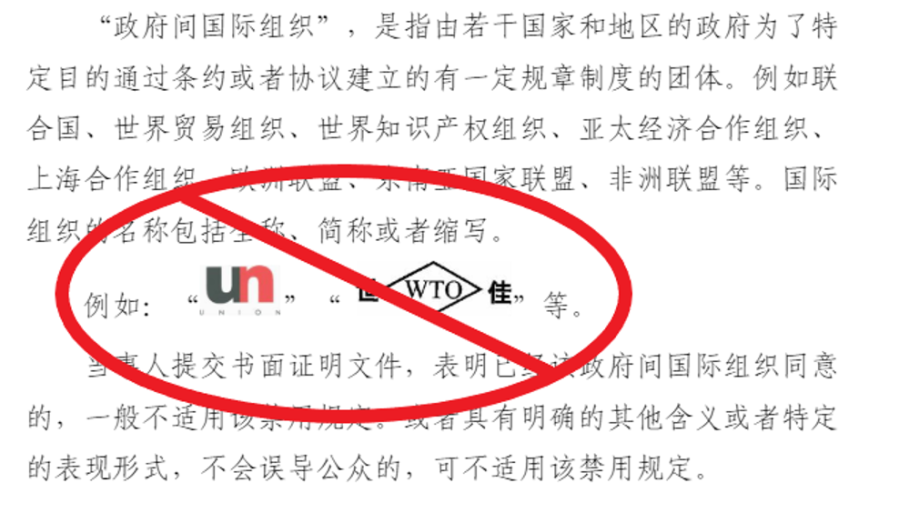
Non-registrable trademarks
In China, there are a number of restrictions on the registration of trademarks. Their purpose is to protect public order, national symbols and international agreements as well as to prevent discriminatory or misleading trademarks. Trademarks that are identical or similar to the names, flags or emblems of countries or national and international organizations are not… Continue reading Non-registrable trademarks

 China Intellectual Property Blog